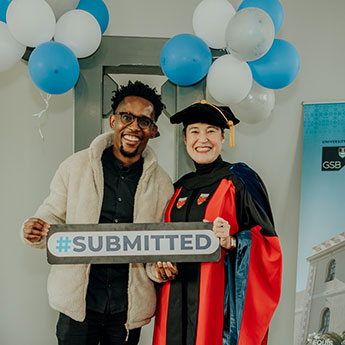
The decision to leave a stable job and pursue a full-time MBA was not an easy one for Simphiwe Petros (MBA Full-Time Class of 2024/25). Reflecting on his journey at the UCT Graduate School of Business, I could tell from Simphiwe’s voice over the phone as he recalls how he carefully he weighed the decision to transform his career by leaving Johannesburg for Cape Town for an unknown future. It was a leap of faith. With the support of his wife and the opportunity of the GSB scholarship, he ultimately chose to take that step.
Now preparing to graduate, Simphiwe has already secured his dream job back in Johannesburg. Looking back, the decision proved to be worth the nerves. In this conversation, he reflects on his MBA journey, the defining moments that shaped his experience, and the impact he hopes to create in the future.
Can you tell us about your professional journey and what led you to pursue your MBA at UCT GSB?
I have a background in Industrial Engineering and Education. Through those two diverse careers, I learnt a lot about myself. I felt that pursuing an MBA would allow me to align these two paths more strategically, while developing the skills and competencies needed to become a better version of myself – someone who sees the world differently.
What problem were you hoping to solve or better understand?
One of the biggest issues I wanted to understand better was inequality in South Africa and the factors that contribute to it. The MBA helped me see the complexity and nuance of the challenges we face, and how they are interconnected rather than isolated.
I still hope to contribute to addressing this issue. My focus will likely centre on improving access to quality education in South Africa. I believe education can be a powerful catalyst for creating a more balanced playing field for the youth of our country.
How would you describe your experience at the GSB?
It was one of the most inspiring and transformational experiences of my life. The MBA reignited my love for learning. It enhanced my ability to absorb information, think critically and strategically, and become more self-aware and empathetic – qualities I believe are essential for great leadership.
“The MBA reignited my love for learning and strengthened my ability to think critically, strategically, and empathetically as a leader.”
Did you have any defining moments that created a major shift in your life?
There were many moments like that, but a few stand out.
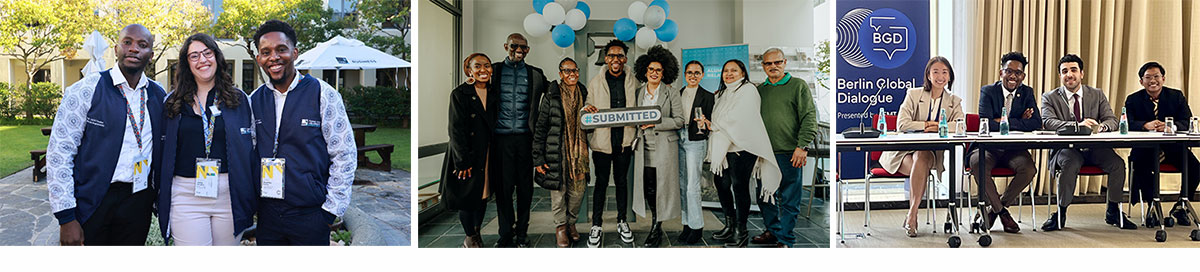
One was taking part in the Negotiation Challenge, where our team was selected as one of the 16 global teams that qualified for the finals.
Another was being selected as a Berlin Global Dialogue Young Voice, where I represented my country and continent among global political and business leaders.
A particularly challenging moment occurred during one of our Advanced Leadership classes, when we explored unconscious wounds. That session helped me confront and release unaddressed trauma from the past. It was one of those unexpected moments during the MBA that deeply impacted me and empowered me to continue becoming who I believe I can be.
In what ways did the programme reshape your thinking as a leader?
The programme helped me truly appreciate the importance of understanding the context of the people experiencing problems, rather than offering solutions based solely on my own experiences.
It encouraged me to adopt a design thinking approach to problem-solving – one that is grounded in empathy and a deep understanding of the people you aim to serve.
“Effective leadership begins with understanding the context of the people experiencing a problem.”
How was the transition back to work after studying full-time?
Life felt like it slowed down dramatically after the MBA. I constantly felt like I needed to be doing something or submitting an assignment, but suddenly there was nothing left to submit.
I was grateful to join an organisation aligned with the work I wanted to do after completing the programme. At the same time, I was incredibly tired after the intensity of the MBA and enjoyed finally catching up on lost sleep.
What does values-based leadership mean to you?
For me, values-based leadership should be the foundation of all leadership. The key is ensuring alignment between espoused values and enacted values. I cannot be an effective leader if I do not say what I do and do what I say I will do.
Within the African context, we share many similar values across nations and communities. Living those values creates the foundation for unity across the continent and allows us to engage globally without compromising who we are.
How has graduating from UCT GSB opened new opportunities for you?
Graduation will be a celebration of the effort and sacrifice that helped me show up more confidently and boldly in the world.
Becoming a UCT GSB alumnus also means joining a diverse network and community from whom I believe I will continue to learn a great deal. The GSB opened my eyes to new opportunities and ways of seeing the world.
How do you see yourself continuing to create impact?
By actively engaging in and developing solutions to the problems that are critical for our future. I want to play a role in decolonising and re-engineering education in South Africa, one child at a time.
“I want to play a role in re-engineering education in South Africa – one child at a time.”
What advice would you give to prospective students?
You will never regret investing in your education. It expands your capacity and enhances the way you engage with the world. You have nothing to lose and everything to gain in becoming who you may never have imagined you could be.
Fast Facts
Programme: MBA Full-Time
Class Year: 2024/25
Current Role: Business Development Manager at Participate Envision Navigate (PEN)
One word to describe UCT GSB: Transformational
Tea or Coffee: Coffee
Soccer Team: Liverpool