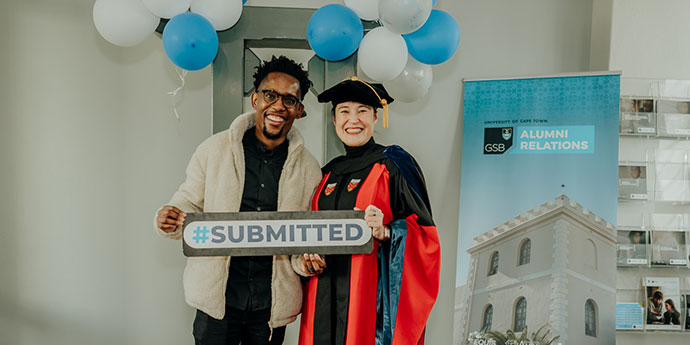
Thirty years ago, the Class of 94/95 MBA at the GSB gave me a platform to test and challenge assumptions and paradigms. Looking back, I'm not sure how much of that came from the curriculum itself, and how much came simply from being in a room with people willing to push back on each other. That thinking has just been recognised in an unexpected way: I was named Engineer of the Year in the 2026 South African Institution of Civil Engineering (SAICE) National Awards.
The award reflects a career of close to four decades working on sustainability, governance, strategy and systemic change across corporates, government and civil society, with civil engineering and transport planning a constant thread and focus throughout. It took a significant change in awareness and a paradigm shift in my own thinking to see that transport should never just be about moving vehicles, which is the current paradigm.
It should always be about how access to opportunity can be provided, safely, affordably and conveniently. The underlying argument runs wider than any one sector. The systems we build, fund and govern either reinforce unsustainable patterns, or they help correct them.
The question I keep coming back to, whatever the sector, is a simple one:
“Are we creating systems that expand genuine, sustainable value and resilience, or are we simply optimising for short-term returns and treating everything else as someone else's problem?”
Whether we notice that difference often starts with language. Take “ecosystem,” a word business regularly uses without a second thought, borrowed from the natural world to describe supply chains, platforms, even entire industries. An ecosystem, properly understood, is a natural, self-regulating, interdependent system governed by energy flows and evolutionary dynamics, not a metaphor to reach for, and many of them are under severe threat, if not already significantly degraded. Financial firms speak of “innovation ecosystems” while running coal-powered data centres; mining houses describe “mineral ecosystems” for supply chains degrading real ones.
Calling a constructed, human-governed arrangement an “ecosystem” makes it sound naturally occurring rather than designed, and lets us confuse what is natural with what is merely normalised. Or take “accident.” We call a collision on the road an “accident,” when in fact almost every crash traces back to a decision someone made. Get the language wrong, and we let ourselves off the hook for decisions that were, in fact, decisions made by people, for reasons, with consequences.

This came home to me most vividly in an incident some years ago at Muizenberg, where I live. Two whales beached themselves, a mother and her calf. The calf kept beaching herself first and the mother kept trying to rescue her, beaching herself in the process. The difficult decision was made to euthanise them both.
The necropsy found the calf had swallowed a sanitary pad, likely washed down a river or discarded from a ship, which had blocked her intestine, starving and weakening her so that she was in danger of drowning. The necropsy on the mother showed she was pregnant. One small, careless act of littering, and three whales died. We rarely see the full chain of consequences our decisions set in motion, because we solve the problem directly in front of us, rather than ask what larger system it sits within.
“We rarely see the full chain of consequences our decisions set in motion, because we solve the problem directly in front of us, rather than ask what larger system it sits within.”
That distinction matters more than ever. We're operating in, and contributing to, a polycrisis: environmental breakdown, biodiversity loss, inequality and geopolitical instability, all compounding and reinforcing each other. The systems being built or reinforced right now will shape the outcome for generations to come.
None of this is meant as judgement of any of us. It's simply the same critical thinking GSB set out to teach, applied here to GSB itself and to each of us. It's worth GSB asking, as it refines its curriculum, how much more deliberately that thinking could be built in. It's worth all of us alumni asking the same of ourselves.
To the Class of 94/95 specifically:
To the wider GSB alumni community: whatever sector or role you're in, I'd ask the same question I keep asking myself. Noticing that distinction, consciously, is the harder and more urgent skill. I hope more of us choose to develop it.
Two organisations sit close to this recognition: the Bicycling Empowerment Network (BEN) South Africa, which I chair, and the Pedal Power Association, where I serve as Vice Chair. Both need the governance, strategy and fundraising thinking a GSB education provides. To see what either does, visit benbikes.org.za or pedalpower.org.za, and do consider a contribution.